Published
8 MIN READ
AI implementation in companies: the stages, in order
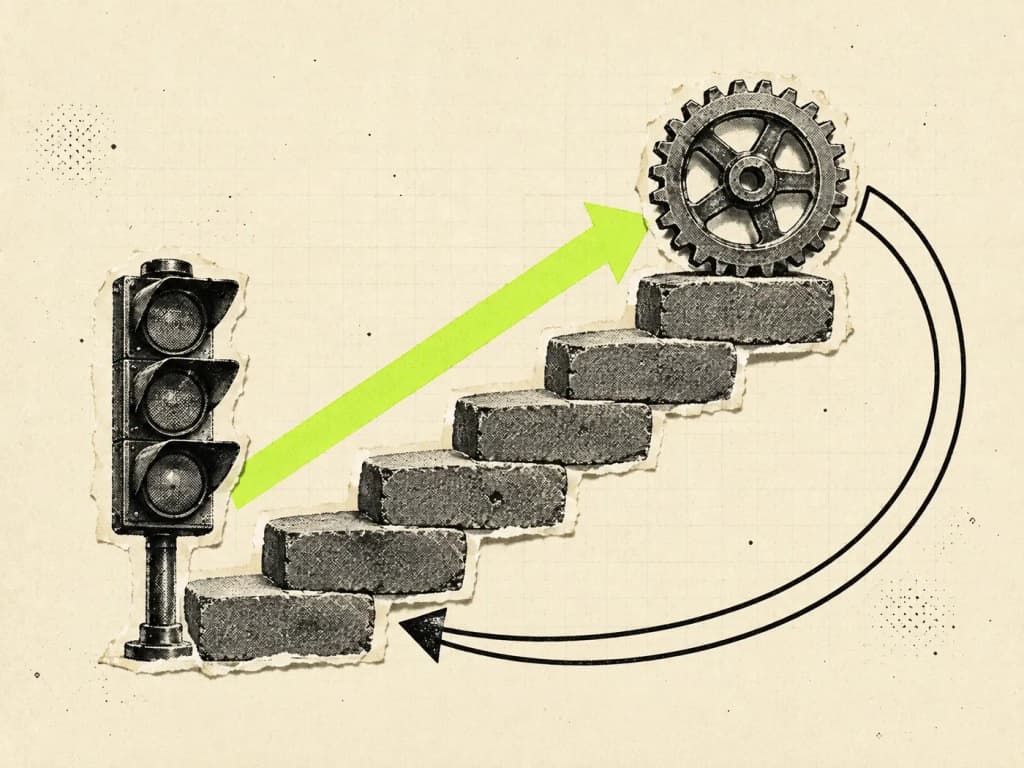

AI implementation in companies is the path that takes artificial intelligence from a loose idea to a process that runs every day, measured and with an owner. It follows six stages in order: assessment, choosing the first use case, pilot, integration, governance and operation. Skipping one of them usually costs more than doing it.
Use is no longer the exception in Brazil. IBGE's semiannual PINTEC survey, released in September 2025, shows that 41.9% of industrial companies with 100 or more employees used artificial intelligence in 2024, up from 16.9% in 2022. Using it, though, is not the same as implementing it: the difference is in the method.
At Wama, implementing artificial intelligence in companies follows the journey of AI Assessment, custom Implementation Plan and execution. If your question right now is about budget, the article on how much it costs to implement AI breaks down the numbers. Here the subject is the order of the stages and what each one needs to deliver.
What are the stages of AI implementation in companies?
AI implementation in companies has six stages, and each one only starts when the previous one has delivered what it promised. The list below sums up what comes out of each stage:
Assessment: the map of the processes where AI comes in and today's baseline (time, volume, rework).
Choosing the first use case: a single process, with a written criterion for why it comes before the others.
Pilot: the use case running at small scale, compared against the baseline and with a stop criterion.
Integration: AI connected to the systems that already exist, with minimum access.
Governance: usage rules, a risk owner and human review defined before scaling.
Operation: monitoring, adjustment and a decision on the next use case.
The order matters more than the name of each stage. Whoever starts with integration finds out late that the chosen process didn't have the volume. The tests for choosing that first workflow are in AI process automation.
Assessment and first use case: the two stages that decide the rest
The assessment and the choice of the first use case define almost the entire cost of the implementation, because that's where you decide what won't be done. An implementation that starts with five open fronts rarely finishes any of them.

Microsoft's AI adoption planning guide recommends assessing each use case against current maturity, data availability, infrastructure and team capacity, and then scoring impact, complexity and effort. The same guide notes that AI projects fail when a company attempts something beyond its technical maturity or the data it has.
In practice, a good first use case is repetitive, has data available and an error that's easy to fix. In Wama's method, the assessment produces the custom Implementation Plan and the baseline for measuring before and after, because each company gets its own plan, with no boxed solution.
How do you run the pilot without putting operations at risk?
Run the pilot in-house, with one process, one team and a comparison against the baseline. Microsoft recommends starting with internal projects, not customer-facing ones, to limit risk while the approach is being tested.
Before turning anything on, write down three numbers: the main metric, the quality metric and the minimum result that justifies moving forward. IBM's AI implementation guide, updated in April 2025, calls for testing with separate validation data and checking for bias and systematic errors before putting the model into use. In customer service, that means checking real answers, not hand-picked examples.
The pilot also needs a stop criterion. If the number doesn't improve within the agreed timeframe, the use case goes back on the list and the next one comes in. An internal help desk that answers the team's questions based on company documents, like an AI agent with a knowledge base, is usually a safe pilot.
Integration and governance: what comes before scaling
Integration and governance are the stages where the pilot becomes a system. They come after the pilot, not before, because it's only worth connecting AI to the CRM or the ERP once you know the use case works.
Integration is where most of the invisible work lives. Customer history scattered between spreadsheets and email decides whether the AI gets it right, as the article on CRM integration with AI shows. The rule is to give the AI only the access the task requires.
That minimum access needs to be described in writing, system by system, as in MCP for companies. Microsoft's AI governance guide follows the NIST AI Risk Management Framework and organizes governance in four steps: assess the risks, document the policies, enforce those policies and monitor.
With personal data in the workflow, governance includes what leaves the company and to which vendor, as detailed in the article on LGPD (Brazil's data protection law) and artificial intelligence.
Who takes part in each stage of the implementation?
Each stage of AI implementation needs three roles: whoever decides, whoever runs the process every day and whoever builds. When one of the three is missing, the stage moves, but it stalls at the next one.
Whoever decides approves the budget, chooses the first use case and signs off on the stop criterion. Whoever runs the process knows the exceptions no map shows: the customer who always asks for a discount, the order that arrives outside the system. Whoever builds turns that into workflow, integration and testing.
IBGE helps show where people are usually missing. Among industrial companies that adopted advanced digital technologies, 54.2% cited a lack of qualified staff as a difficulty, and 45.1% cited the difficulty of integrating business areas.
Governance also has an owner. At Wama, every AI output gets a human read before it goes to the client, and that review is part of the process design from the pilot on. The internal rule that says what the team can put into the tools is in the AI usage policy.
Common mistakes
The most expensive mistakes in AI implementation happen outside the technology, when the company skips a stage to get to the next one faster.
Buying the tool before the assessment. The license becomes the starting point, and the process is chosen to justify the purchase.
Skipping the baseline. Without today's number, no pilot can be approved or shut down with an argument.
Running the first pilot with customers. A mistake by the AI agent on WhatsApp shows up for the buyer; an internal mistake shows up for the team.
Opening five fronts at the same time. Each front calls for integration and review, and the team gets split across all of them.
Treating go-live as the end. IBM points out that data and needs change, and evaluation has to continue after the system goes into use.
Leaving governance for later. A rule created after the incident arrives too late.
Frequently asked questions
How long does AI implementation take in a company?
The timeline depends on the chosen use case, the state of the data and the number of systems involved, so there's no honest number before the assessment. What you can plan is the order: assessment, first use case, a pilot with a fixed timeframe and only then integration. Microsoft's guide suggests using the pilot result to estimate the following schedules.
Do I need a data team to implement AI?
Not to get started. Many generative AI use cases work with the data the company already has, as long as it's organized and accessible. Microsoft's guide classifies maturity in four levels and shows that the first projects call for basic knowledge and available corporate data. A specialized team comes in when the use case requires training your own model.
What's the difference between an assessment and an implementation plan?
The assessment answers where AI comes in and measures how each process works today. The plan says how to do it: stages, owners, integrations, stop criteria and the order of use cases. At Wama, the AI Assessment produces the custom Implementation Plan, and the assessment fee is deducted from the first installment when the client moves on to the plan.
Can you implement AI without replacing current systems?
In most cases, yes. The implementation connects AI to the systems the company already uses, such as CRM, ERP and spreadsheets, with access limited to what each task needs. Replacing a system only comes up when the current one doesn't allow reading or writing data in any way, and that evaluation is part of the assessment.
How do you implement AI in a company in a regulated industry?
In a regulated industry, governance moves to the front of the line: a risk owner, a record of decisions and human review come in before the pilot, not after. It's also worth checking the regulator's rules on data and outsourcing. If you build financial products, the article on AI for fintechs shows what the app needs to have.
If your company wants to implement AI in order, starting with the process and not the tool, talk to Wama about the AI Assessment.